Supreme Court Upholds Bihar Voter List SIR, Says It Is Vital for Free and Fair Elections
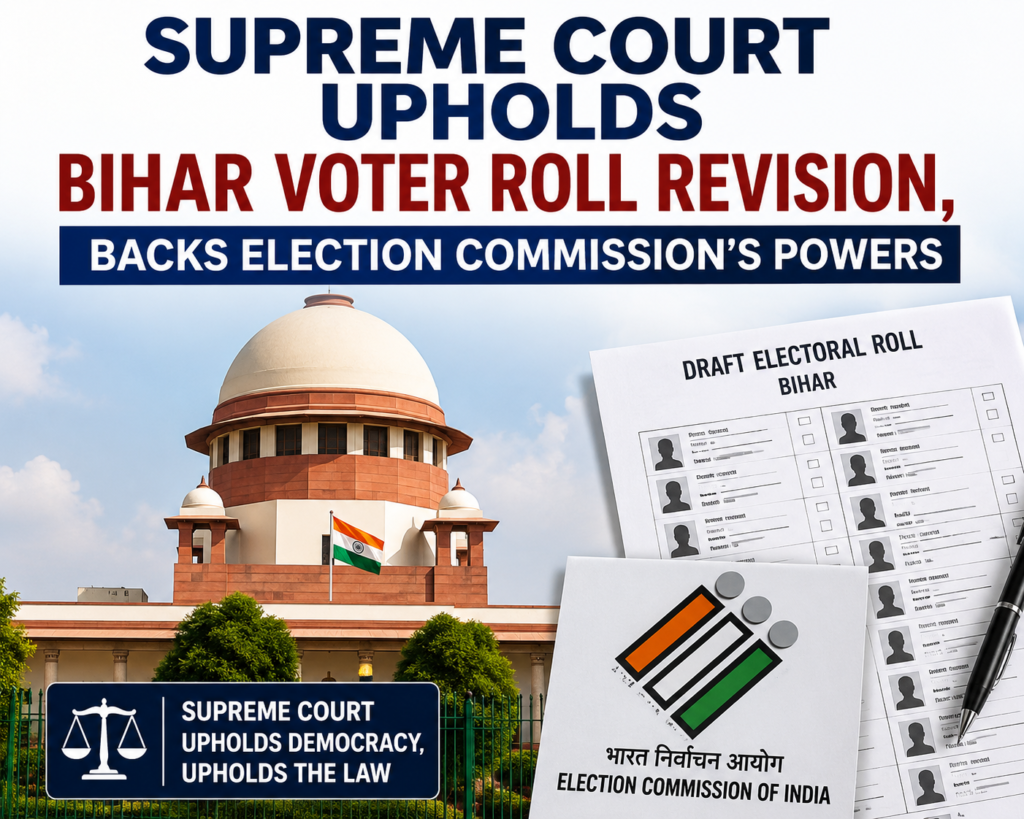
The Supreme Court has upheld the constitutional validity of the Special Intensive Revision (SIR) of Bihar’s electoral rolls. A bench comprising Chief Justice of India Surya Kant and Justice Joymalya Bagchi ruled that the exercise falls within the Election Commission’s constitutional duty to maintain a clean, accurate, and reliable voter list.
The court observed that free and fair elections depend not only on the voting process but also on the purity and authenticity of electoral rolls. Rejecting the petitioners’ claim that the SIR was a backdoor citizenship verification exercise aimed at identifying infiltrators, the bench clarified that the Election Commission can examine citizenship-related aspects only for the limited purpose of including or retaining names in the voter list and cannot make a final determination on citizenship.
Five Key Takeaways from the Judgment
1. Election Commission’s Authority The court held that Article 324 of the Constitution entrusts the Election Commission with ensuring fairness throughout the electoral process. Section 21(3) of the Representation of the People Act empowers the Commission to conduct Special Intensive Revisions across an entire state. While Parliament may enact election laws, such legislation does not diminish the Commission’s constitutional powers.
2. Citizenship Decisions Rest with the Central Authority The court clarified that the Election Commission cannot independently decide citizenship disputes. If doubts arise regarding a person’s citizenship, the matter must be referred to the competent central authority. The Commission must provide reasons before removing any name from the electoral roll. The bench also emphasized that the SIR is not equivalent to the NRC process.
3. Aadhaar, Ration Card and Voter ID According to the court, Aadhaar can establish identity but is not proof of citizenship. A voter ID card is generated from the electoral roll and therefore cannot serve as conclusive evidence of citizenship. The court did not interfere with objections concerning the use of ration cards.
4. Removal from Draft Roll Is Not Final The court noted that deletion of a name from the draft electoral roll does not amount to final removal. Affected individuals have access to claims, objections, hearings, appeals, and judicial review, ensuring protection against arbitrary exclusion.
5. Timeline for Citizenship-Related Cases Cases in which names are removed due to doubts about citizenship must be referred by the Election Commission to the competent central authority within four weeks. The authority will then decide the matter. The court said efforts should be made to resolve such cases before the next election, whether Lok Sabha, Assembly, or local body polls. If a person is found to be a citizen, their name will be restored to the electoral roll. Individuals whose names are removed due to reasons such as death, migration, absence, or duplication may challenge the Commission’s decision through legal remedies if they remain eligible voters in Bihar.
What Happens Next?
The judgment provides significant legal backing for Special Intensive Revisions in other states. Under the Election Commission’s notification dated May 14, similar exercises are set to be undertaken in Andhra Pradesh, Arunachal Pradesh, Haryana, Jharkhand, Karnataka, Maharashtra, Manipur, Meghalaya, Mizoram, Nagaland, Odisha, Punjab, Sikkim, Telangana, Tripura, Uttarakhand, Delhi, Chandigarh, and Dadra & Nagar Haveli and Daman & Diu.
Posted inTOP STORIES