
Supreme Court Cracks Down on Waste Management Violations
District Collectors Made Accountable; Four-Way Waste Segregation Mandatory for Every Household
The Supreme Court has taken a strict stance on the implementation of Solid Waste Management Rules across the country. A bench comprising Justices Pankaj Mittal and SVN Bhatti is set to review the matter after examining compliance reports submitted by states.
During the previous hearing on May 5, the court directed that waste must be segregated into four categories at the source itself. Chief Secretaries of all states had participated virtually in that hearing. The Centre was instructed to submit a nationwide progress report by May 24, which will now be reviewed by the court.
Hearing a petition filed by Dr. Subhash Chandra Pandey, the court observed that the situation has reached a “now or never” stage and stressed that both governments and citizens are equally responsible for implementing the law passed by Parliament.
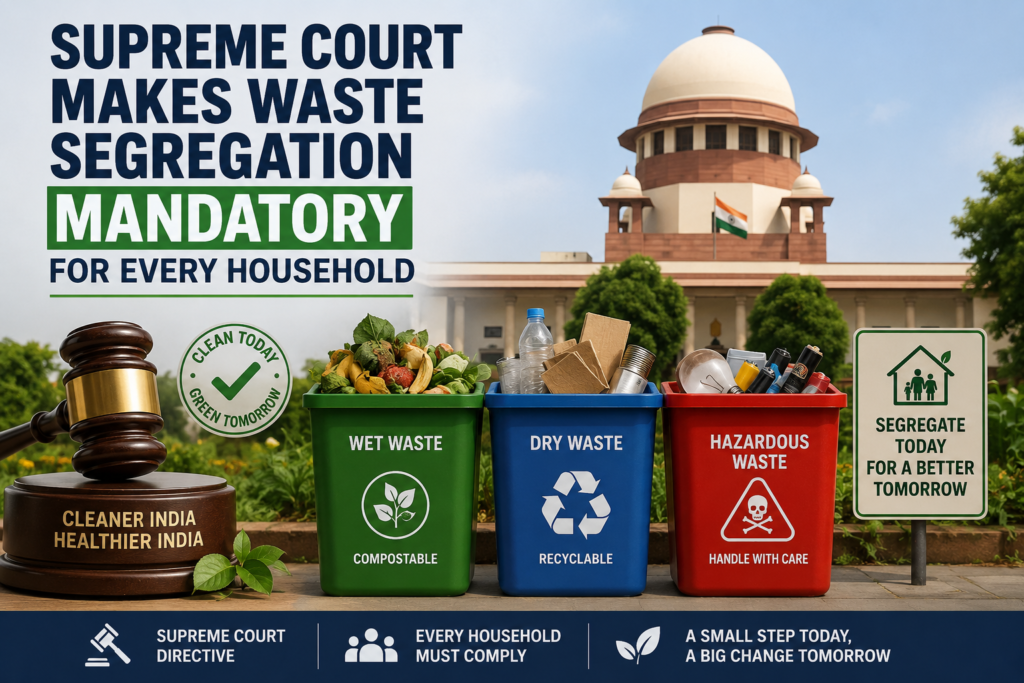
Four Categories of Waste Segregation Mandatory
Under the court’s directives and existing Solid Waste Management Rules, every household, apartment complex, colony, and locality must separate waste into four categories:
Wet Waste: Kitchen waste, leftover food, biodegradable materials
Dry Waste: Plastic, paper, glass, and recyclable items
Sanitary Waste: Diapers, sanitary napkins, and similar waste
Special Waste: E-waste, batteries, syringes, and hazardous household items
Resident Welfare Associations (RWAs), housing societies, and apartment complexes must ensure segregation within their premises. Wet waste must also be composted or processed on-site. Failure to comply may invite action from local bodies, including penalties.
District Collectors Held Responsible
The Supreme Court has made District Collectors directly responsible for enforcing waste management rules. Collectors must create a dedicated section on district websites to upload reports, photographs, and progress updates related to waste management and disposal of old garbage dumps.
The court also directed strict action against illegal dumping and transportation of waste. Garbage transport vehicles must be covered and enclosed, and open dumping has been prohibited.
Strict Rules for Hotels, Malls, Hospitals
Hotels, malls, large hospitals, government and private offices, and large residential complexes will be treated as “bulk waste generators.” These establishments must undergo waste infrastructure audits and ensure separation of dry and wet waste within their premises. On-site treatment of wet waste has been made compulsory.
Authorities may suspend water and electricity connections for serious violations.
Monitoring Committee Formed
The Supreme Court has constituted a national monitoring committee to oversee compliance and curb illegal dumping and transportation of waste. The Member Secretary of the Central Pollution Control Board will act as its convener, along with officials from five central ministries.
The committee has been empowered to monitor implementation, issue directions, and review compliance across states.
Railways Also Brought Under Scrutiny
For the first time, the court included the Railways within the ambit of waste management enforcement. The bench noted that railway stations, platforms, and tracks generate huge quantities of waste daily and asked the monitoring committee to seek detailed reports from railway authorities regarding existing systems and future plans.
Focus on Public Awareness and Schools
The court emphasized that waste management should become a social habit rather than merely a government scheme. It directed that practical lessons on waste management be included in school education so children can act as “guides and mentors” within families.
District Collectors have also been allowed to launch awareness campaigns by selecting schools and residential areas as model projects.
Grants May Be Withheld for Non-Compliance
Local bodies have been directed to earmark a fixed portion of their budget for sanitation and waste management. Failure to implement the rules could result in reduction or suspension of central and state grants.
Officers Cannot Be Transferred
The court further ruled that officers working under the Swachh Bharat Mission should not be transferred until mission targets are achieved. If removal becomes necessary, state governments must seek permission from the Supreme Court-appointed monitoring committee and provide valid reasons such as poor performance or special circumstances.
Citing Mahatma Gandhi’s quote, “He who eats without physical labor eats stolen food,” the court underlined the shared responsibility of citizens in maintaining cleanliness and protecting the environment. It also ordered that its directions be translated into local languages and widely circulated to raise awareness.
Posted inTOP STORIES