
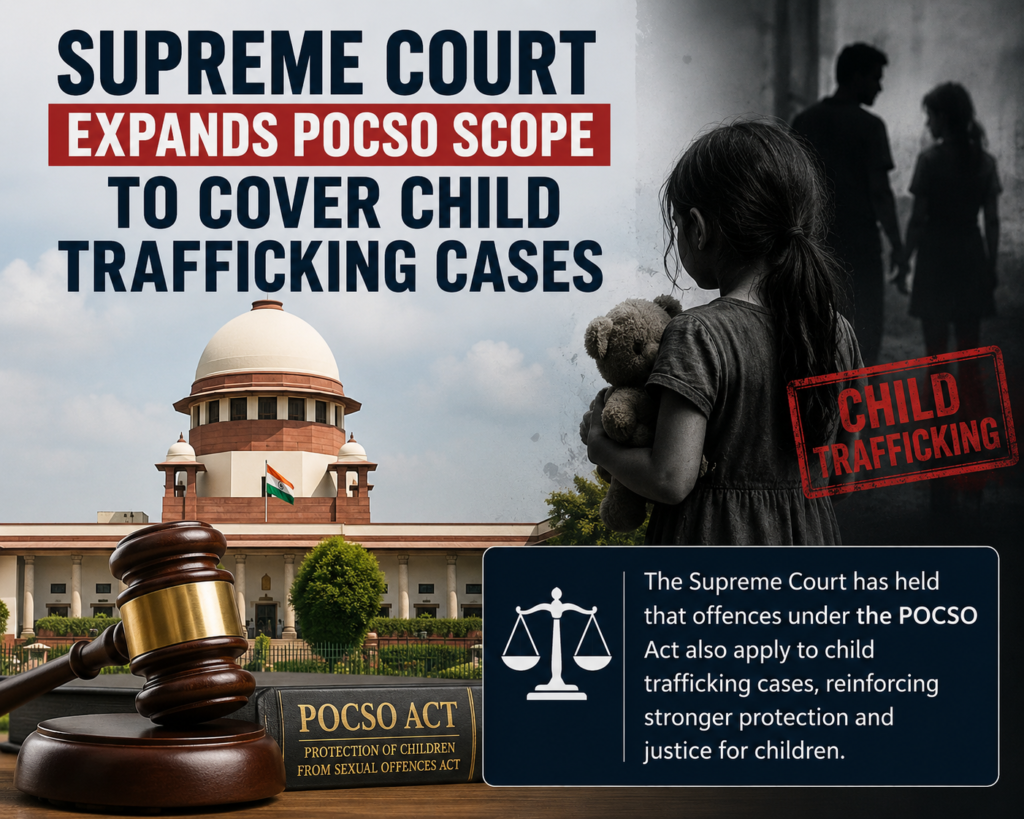
In a significant ruling, the Supreme Court has held that cases involving the trafficking of minors for commercial sexual exploitation can also be prosecuted under the Protection of Children from Sexual Offences (POCSO) Act. The Court clarified that, depending on the facts of the case, provisions of the Indian Penal Code (IPC) and the Immoral Traffic (Prevention) Act (ITPA) may also be invoked.
A bench comprising Justices J.B. Pardiwala and R. Mahadevan emphasized that in trafficking cases, the focus must be on the methods employed and the intent of the accused, rather than on the victim’s consent.
The Court observed that consent becomes legally irrelevant when it is obtained through threats, kidnapping, fraud, deception, abuse of authority, exploitation of a vulnerable situation, or the promise of money or other benefits. It further noted that a person may still be considered a victim of trafficking even if they are aware that they are being pushed into prostitution or the commercial sex trade.
The bench also issued a series of directions aimed at addressing concerns and safeguarding the rights and dignity of sex workers.