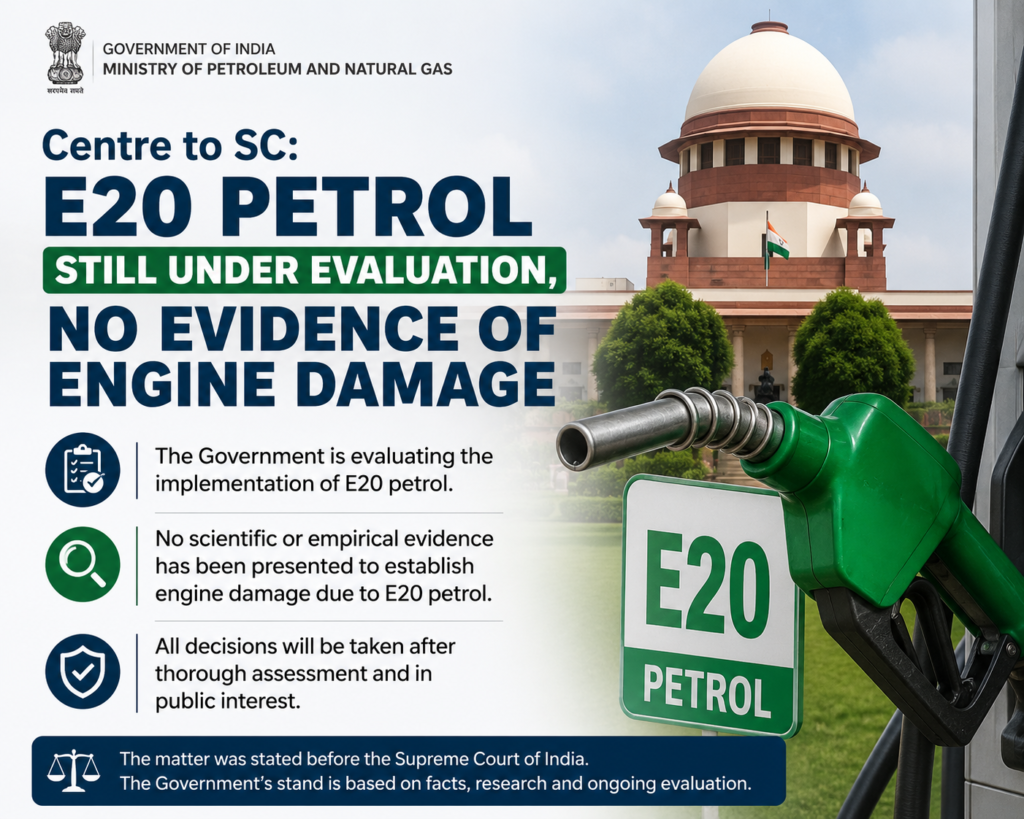
Centre Tells Supreme Court E20 Petrol Is Still Under Evaluation; No Proof Yet of Engine Damage
The Central Government has informed the Supreme Court that the nationwide rollout of E20 petrol—fuel blended with 20% ethanol—is still being evaluated, with its impact on vehicles and the economy under study. The assessment is expected to be completed by next year.
The submission comes amid growing concerns among owners of older vehicles that E20 petrol could adversely affect engine performance and durability.
Representing the Centre, Attorney General R. Venkataramani told the court that there is no conclusive scientific evidence to establish that E20 fuel causes damage to vehicle engines or components.
The government has promoted E20 blending as part of its strategy to reduce crude oil imports, cut vehicular emissions, and boost demand for domestically produced ethanol, benefiting farmers and the ethanol industry.
The remarks were made during the hearing of petitions challenging a Karnataka High Court order directing state-owned oil marketing companies to reconsider increasing the ethanol procurement quota for a private ethanol manufacturer. The oil companies argued before the Supreme Court that ethanol supply contracts had already been finalized through October 2025.
The Supreme Court has ordered that the status quo be maintained, allowing the High Court’s direction to remain in effect until the matter is decide.
Bhaskar Explainer –
Will using E20 petrol affect your vehicle insurance?
No. The use of E20 petrol does not affect the validity of a vehicle’s insurance policy.
Is my vehicle compatible with E20 petrol?
Most cars and two-wheelers manufactured after April 2023 are designed to run on E20 fuel. Owners can confirm compatibility by checking for an “E20” label on the fuel tank cap or by referring to the owner’s manual. Vehicles manufactured before 2023 were generally not designed for E20 fuel, and owners are advised to verify compatibility with the vehicle manufacturer before making the switch.