
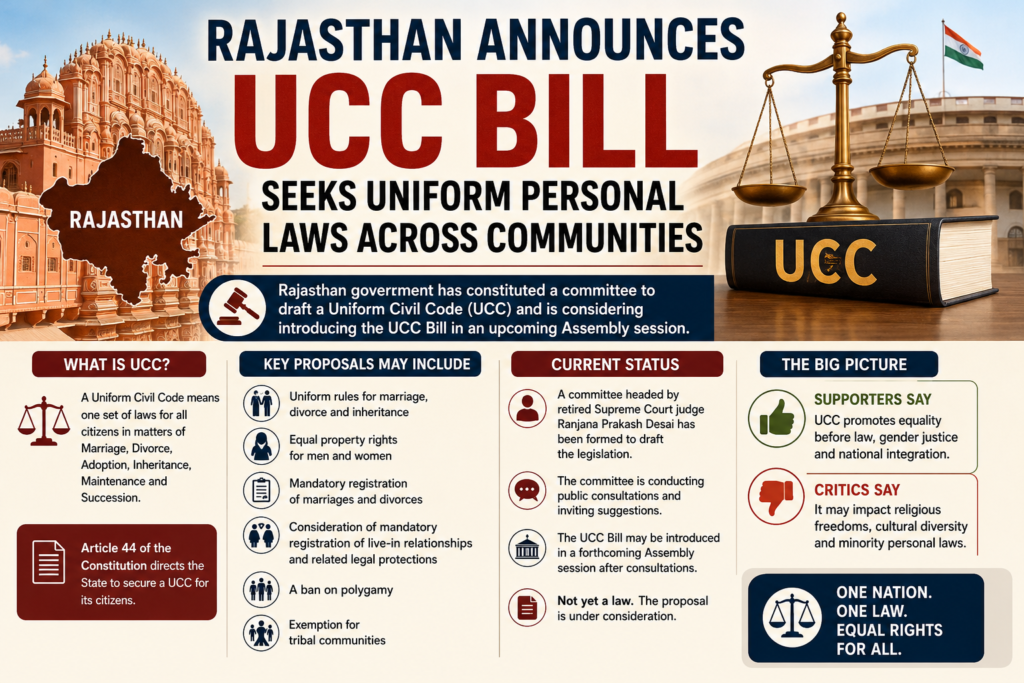
Rajasthan Set to Introduce Uniform Civil Code; Tribal Communities Exempt
The Rajasthan government has announced its decision to introduce a Uniform Civil Code (UCC), making it one of the latest states to move towards a common civil law governing personal matters. The proposed legislation will apply to all citizens irrespective of religion or community, while excluding tribal communities from its ambit.
The UCC will replace religion-based personal laws in matters such as marriage, divorce, inheritance, adoption, and maintenance. Among its key provisions are a ban on polygamy, compulsory registration of marriages, divorces, and live-in relationships, and equal inheritance rights for sons and daughters.
The decision to introduce the Rajasthan Uniform Civil Code Bill, 2026 was approved by the Council of Ministers on April 14. Law Minister Jogaram Patel and Minister of State for Home Affairs Jawahar Singh Bedham said the proposed law seeks to establish a uniform legal framework for personal matters across all communities in the state.
To prepare the draft legislation, the government has constituted a high-level committee headed by retired Supreme Court judge Justice Ranjana Prakash Desai. The committee includes retired IAS officer Shatrughan Singh, Additional Advocate General of the Rajasthan High Court Basant Singh Chaba, former Government Law College principal Ramswaroop Agarwal, and Dr. Shuchi Chauhan. The Additional Chief Secretary of the Home Department will serve as the committee’s Member Secretary.
The committee has been tasked with consulting stakeholders and inviting suggestions from the public before submitting its recommendations. Based on its report, the government will draft and introduce the bill in the State Assembly.
The state government has cited Article 44 of the Constitution, which directs the State to endeavour to secure a Uniform Civil Code for all citizens, as the constitutional basis for the initiative. Officials said the proposed law aims to ensure legal uniformity, promote gender equality, and provide equal rights in matters of family law.
Rajasthan joins a growing list of states that have either implemented or initiated steps towards a Uniform Civil Code. Uttarakhand has already implemented a UCC that mandates registration of marriages, divorces, and live-in relationships, prohibits polygamy and practices such as Nikah Halala and Iddat, and provides equal inheritance rights for women.
Gujarat has announced plans to enact a UCC in 2026, proposing uniform laws on marriage, divorce, inheritance, and adoption, along with mandatory registration of live-in relationships and legal protection for women and children in such relationships.
In Assam, the government has passed a law banning polygamy and has expressed its commitment to implementing a Uniform Civil Code. The state has also proposed measures to prohibit practices such as Nikah Halala and Mutah (temporary marriage) and to raise the minimum legal age of marriage for women to 21 years. The proposal is currently awaiting Presidential approval.
Meanwhile, Madhya Pradesh, Maharashtra, and Chhattisgarh have constituted committees or initiated consultations to prepare draft legislation on the subject.
Goa remains the only Indian state with a long-standing Uniform Civil Code. Its civil law, commonly known as the Goa Civil Code, traces its origins to the Portuguese Civil Code of 1867 and has remained in force since Goa’s integration into India.