
Supreme Court Seeks NTA Reforms, Calls NEET Paper Leak a Failure of Accountability
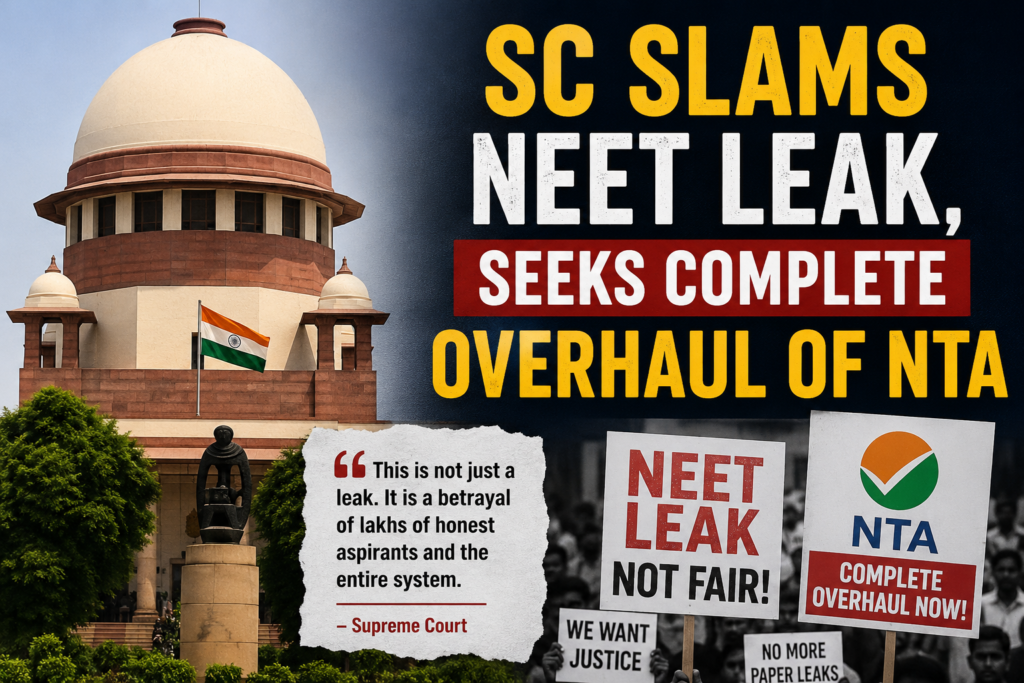
The Supreme Court on Friday made strong observations while hearing petitions related to the NEET paper leak case, emphasizing the need for clear accountability and structural reforms in the examination system.
A bench comprising Justices P.S. Narasimha and Alok Aradhe remarked that examination-related failures are extremely sensitive matters. The court observed that when irregularities occur, identifying responsibility becomes difficult because accountability is often fragmented.
“The real problem will remain unresolved until accountability is clearly fixed,” the bench said.
Describing the paper leak and subsequent cancellation of examinations as “painful” and “deeply saddening,” the court noted that the consequences extend beyond students themselves.
“We cannot disappoint our students. This is not just about one student; entire families invest years of effort, emotion, hope, and resources in these examinations,” the court observed.
Solicitor General Tushar Mehta informed the court that Prime Minister Narendra Modi is personally monitoring the issue and that the government is deeply concerned about the future of young aspirants.
The bench further remarked that many institutions in India function in an ad hoc manner, resulting in recurring systemic failures. The court directed the Ministry of Education, rather than the Ministry of Health, to file a detailed affidavit explaining how large-scale national examinations should be conducted and what reforms are required.
Court Questions High-Level Committee
The court directly questioned Dr. K. Radhakrishnan, former ISRO chairman and head of the high-level committee constituted to review NTA’s functioning.
“Despite close monitoring, how did the leak occur? What vulnerabilities remained unnoticed by the committee?” the bench asked.
Dr. Radhakrishnan responded that weaknesses existed primarily in the question paper-setting process. He assured the court that safeguards are being strengthened and similar lapses would not recur during future examinations and retests.
Why UPSC Is Considered More Secure Than NTA
UPSC’s Strengths
Constitutional Status – Established under Article 315, UPSC enjoys institutional autonomy with clearly defined accountability.
Permanent Administrative Cadre – It relies on an in-house workforce rather than outsourced personnel.
Blind Question-Paper Selection – Paper setters do not know which question paper will ultimately be used.
Secure In-House Printing – Printing takes place in highly secure and isolated facilities.
Government-Controlled Logistics – Transportation and storage are managed through state agencies and strong-room security.
Trusted Examination Centres – Exams are conducted primarily in government institutions and reputed educational establishments.
Analytical Examination Pattern – The subjective nature of many UPSC examinations reduces the impact of answer-key leaks.
Challenges Faced by NTA
Non-Constitutional Structure – NTA functions as a society and lacks a dedicated permanent cadre.
Dependence on Outsourcing – Private vendors are often involved in printing, logistics, and technical operations.
Large Network of Examination Centres – Conducting exams for millions of candidates necessitates the use of numerous private institutions.
Transportation Vulnerabilities – Question papers may pass through multiple layers of handling before reaching centres.
OMR-Based Objective Format – Multiple-choice examinations are more vulnerable to answer-key leaks and solver-gang operations.
Single-Point Failure Risk – A security breach at one location can compromise the credibility of the entire examination.
Fragmented Accountability – Responsibility is spread across multiple agencies, vendors, and committees.
Posted inTOP STORIES