
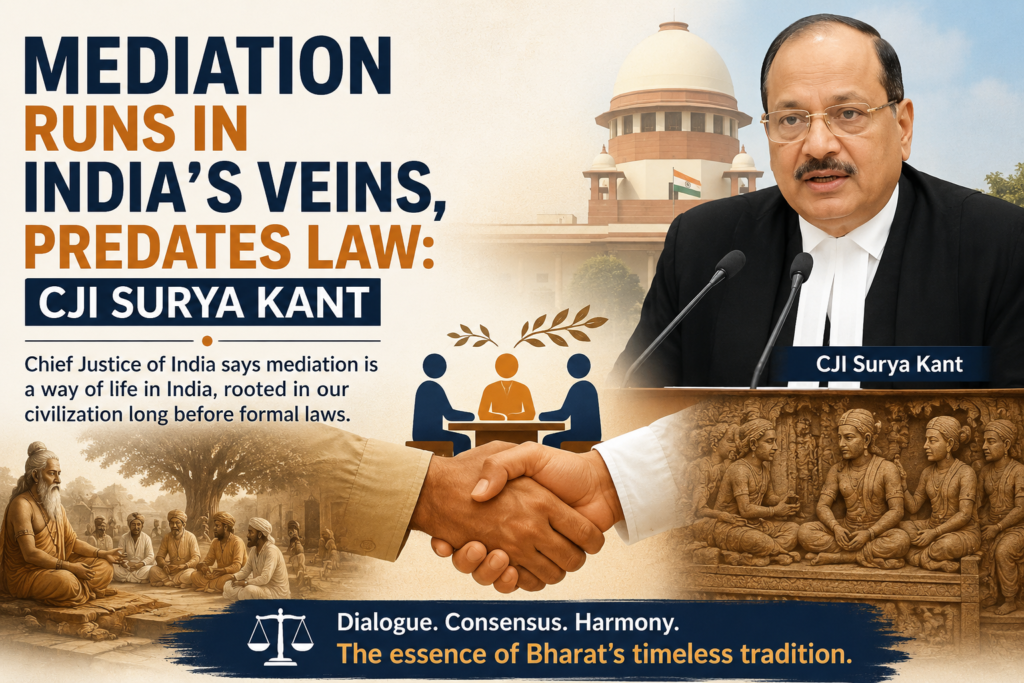
Mediation Part of India’s Civilizational Ethos, Says CJI Surya Kant
Chief Justice of India (CJI) Surya Kant on Saturday emphasized that mediation and compromise are deeply rooted in India’s civilizational values and have long served as effective methods for resolving disputes. Addressing the second day of the three-day conference on “Peace, Mediation and the Rule of Law,” he said mediation is not merely a legal mechanism but a modern expression of India’s age-old tradition of resolving conflicts through dialogue, consensus, and mutual trust.
The CJI noted that Mahatma Gandhi regarded facilitating settlements between disputing parties as one of the most rewarding aspects of legal practice. He said the spirit of mediation existed in Indian society long before it was formally recognized by law.
Highlighting the purpose of mediation, Justice Surya Kant said the legal system does not require every dispute to end in litigation. Instead, the objective is to ensure affordable, dignified, and accessible justice for all citizens.
Illustrating the difference between litigation and mediation, he shared the story of two sisters disputing ownership of an orange. It was later discovered that one wanted only the peel while the other needed the juice. “Litigation decides who gets the orange, while mediation seeks to understand who needs which part of it,” he remarked.
The CJI also pointed out that India has a centuries-old culture of resolving disagreements through dialogue, from village panchayats to family settings.
Supreme Court Justice Vijay Bishnoi said that although mediation has received formal legal recognition only in recent years, it has historically played a significant role in settling social disputes across Indian villages and communities. He stressed that every legal case involves individuals seeking justice, dignity, and peace of mind, not merely the resolution of a legal issue.
Justice Pushpendra Singh Bhati observed that when mediation was initially introduced in Rajasthan, many doubted its practicality. However, over time it proved to be an effective tool for resolving even large and complex disputes.
Adding a lighter touch to the discussion, Acting Chief Justice S.P. Sharma remarked that the mother is often the first mediator in a family, settling disagreements among children. If her efforts fail, he joked, the father steps in as the second mediator.
Deputy Chief Minister Prem Chand Bairwa and Advocate General Rajendra Prasad also addressed the gathering, describing mediation as a valuable and effective alternative to conventional court proceedings.