Supreme Court: Online Gambling Not a Fundamental Right, Upholds State Laws and 28% GST
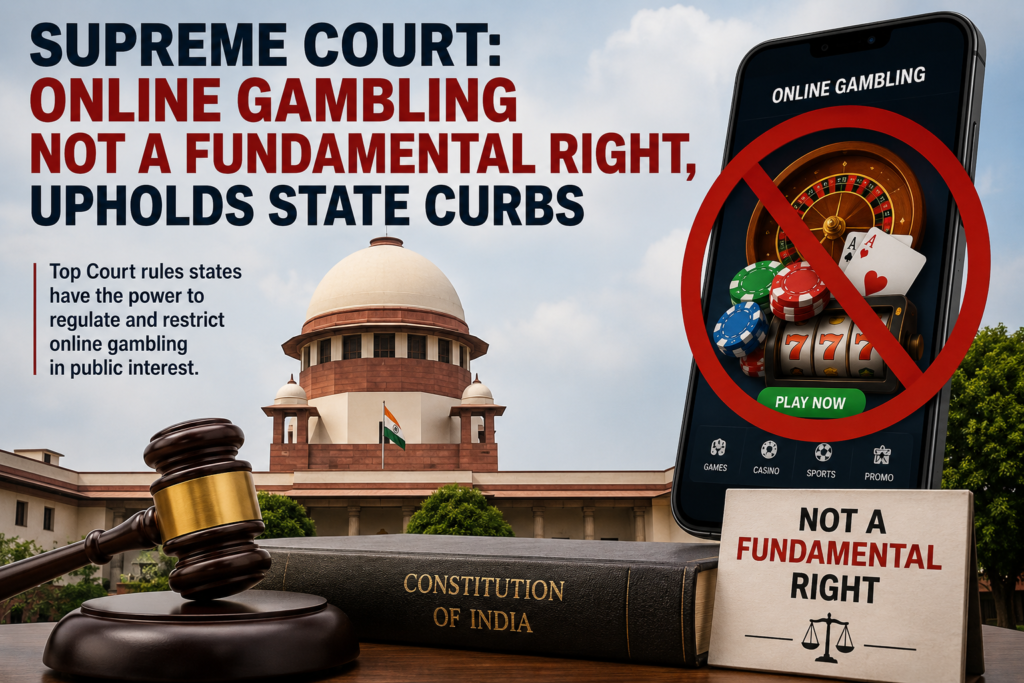
In a significant judgment on online gaming and gambling, the Supreme Court has ruled that gambling is not a fundamental right and cannot be protected under the constitutional right to carry on business. The Court observed that gambling falls outside the scope of legitimate trade and business activities.
A bench comprising Justices J.B. Pardiwala and R. Mahadevan set aside earlier rulings of the Madras High Court and the Karnataka High Court, upholding the laws enacted by Tamil Nadu and Karnataka that criminalize online games played for money or stakes. The decision covers games such as rummy, poker, and fantasy sports when played for monetary rewards.
The Court clarified that state governments have the authority to regulate or prohibit games involving money, regardless of whether they are based on skill or chance.
Key Highlights of the Judgment
1. States Can Restrict Real-Money Gaming
The Supreme Court held that betting and gambling are not protected as fundamental rights. Therefore, states can regulate or prohibit games involving wagering or stakes in the interest of public health, public order, and public welfare.
2. 28% GST on Full Deposit Value Upheld
The Court also upheld the levy of 28% GST on the entire amount deposited by users on online gaming platforms. Petitions filed by several gaming companies, including Delta Corp, challenging the tax demand were dismissed. The dispute centered on retrospective tax notices, which seek to apply tax liability to past transactions.
3. Centre Cites Online Gaming Act, 2025
The Union Government relied on the Promotion and Regulation of Online Gaming Act, 2025, which was passed by Parliament in August 2025 and received Presidential assent on August 22, 2025. Gaming companies argued that imposing retrospective GST demands was unfair, particularly when the new law had already introduced a regulatory framework for online money gaming.
4. Industry Concerns Rejected
The companies further contended that skill-based games should not be treated on par with gambling. However, the Supreme Court ruled that once money or stakes are involved, states are empowered to impose restrictions. The Court also reaffirmed the validity of the 28% GST regime.
The judgment is expected to have a major impact on India’s online gaming sector, estimated at around $3.5 billion, with industry players warning of higher costs, business disruptions, and job losses.