
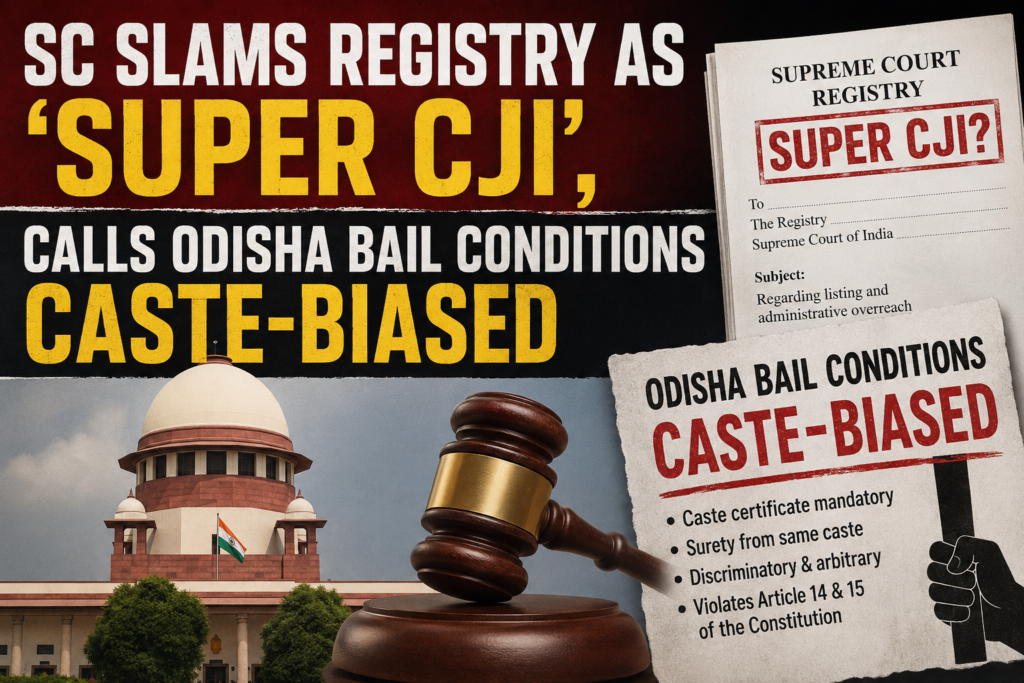
The Supreme Court of India on Monday strongly reprimanded its own registry, calling its functioning arbitrary and improper. During the hearing of a ₹37,000 crore investment scam case, the apex court remarked that every registry official had started behaving like a “Super Chief Justice of India.” The court expressed anger after the Enforcement Directorate (ED) was not issued notice despite a clear court order.
A bench comprising Chief Justice Surya Kant and Justice Joymalya Bagchi was hearing the bail plea of Ayushi Mittal, accused in the alleged ₹37,000 crore investment fraud case. Referring to an earlier order dated March 23, the Chief Justice questioned how registry officials assumed that the bench had not intended to summon the ED and other parties in the matter.
The bench later allowed the Rajasthan government’s oral request to implead the ED in the case and directed that notice be issued. The matter will now be heard in May. Ayushi Mittal, her husband, and their company are accused of large-scale financial fraud. The defence argued that a substantial portion of investors’ money has already been returned, while several hundred crores remain frozen in ED-controlled bank accounts.
In another significant observation, the Supreme Court of India expressed strong displeasure over certain bail conditions imposed by courts in Odisha, particularly on Dalit and tribal accused. The court said that directing accused persons to clean police stations or perform similar tasks in exchange for bail amounts to a violation of human rights.
The bench led by CJI Surya Kant stated that such orders reflect a conservative and caste-biased mindset against marginalised communities. The court noted that such conditions are rarely imposed on affluent accused persons, creating a caste-based image of the Odisha judiciary.
Many of these cases reportedly involved Dalit and tribal individuals accused during anti-mining protests in the state. According to reports placed before the court, nearly 50 such orders were passed by the Odisha High Court in the last six months.
Declaring such bail conditions invalid, the Supreme Court ordered that they must not be replaced with similar conditions in future cases. The court also issued a warning to courts across the country, stating that judicial orders should not carry caste overtones or deepen social tensions.
Posted inTOP STORIES