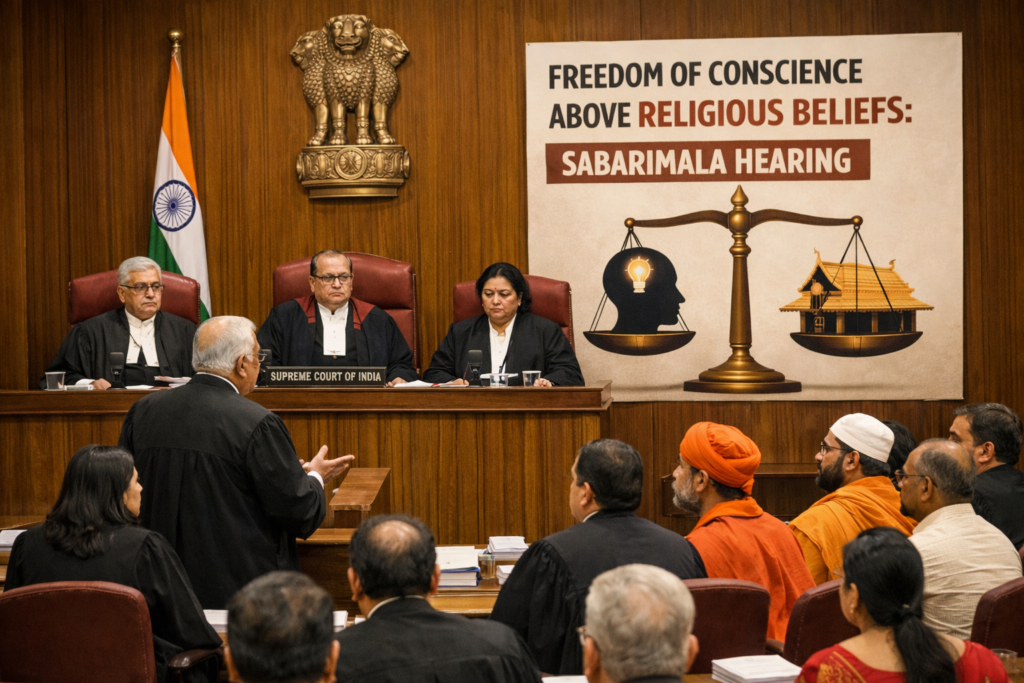
The Supreme Court on Friday observed that while deciding matters of faith, constitutional authorities must rise above their personal religious beliefs. The Court emphasized that issues involving religion must be examined through the lens of freedom of conscience and the broader constitutional framework. A nine-judge Constitution bench headed by CJI Surya Kant made the remark while hearing a reference related to the entry of women into the Sabarimala temple. The observation came in response to arguments by senior advocate Rajeev Dhavan highlighting the importance of freedom of conscience.
The bench also addressed the ongoing debate on whether courts should interfere in religious matters. It indicated that when constitutional rights are involved, simply invoking “religion” cannot shield a practice from judicial review. Rajeev Dhavan argued that freedom of conscience is expansive and includes the right to respectfully question any religious system. The Court is currently examining the relationship between religion, conscience, and Articles 25 and 26 of the Constitution.
Day 5: Arguments for religious autonomy
Advocate M.R. Venkatesh, appearing for the Atmartham Trust, argued that temples cannot be treated like public spaces such as railway stations or bus stands. He submitted that the practice of women refraining from visiting temples during menstruation is based on faith and cannot be tested on scientific grounds.
Senior advocate V. Giri contended that in Hindu belief, an idol is not merely a stone but a living deity with specific attributes. Preserving those attributes and associated rituals, he argued, is the true essence of worship and should not be altered.
Justice Amanullah observed that freedom of conscience has a wide scope and is distinct from personal religion. He noted that while religion may be personal to a judge, judicial decisions must rise above individual religious beliefs and remain guided by constitutional principles.
Citing B.R. Ambedkar, Venkatesh argued that the framers of the Constitution distinguished between “untouchability” and temporary impurity arising from biological causes. According to him, equating the two in the Sabarimala context would be inconsistent with constitutional intent.
Several parties also invoked Article 26, arguing that religious denominations have the right to manage their internal affairs and that courts should not interfere with long-standing traditions.
Article 25 guarantees individuals the freedom to profess, practice, and propagate religion, while Article 26 grants religious denominations the right to manage their religious institutions and affairs.
Background
In 2018, a five-judge Constitution bench, by a 4:1 majority, allowed women of all ages to enter the Sabarimala temple, ending the practice that barred menstruating women from entry. Multiple review petitions were subsequently filed, leading to the present reference before the nine-judge bench.