
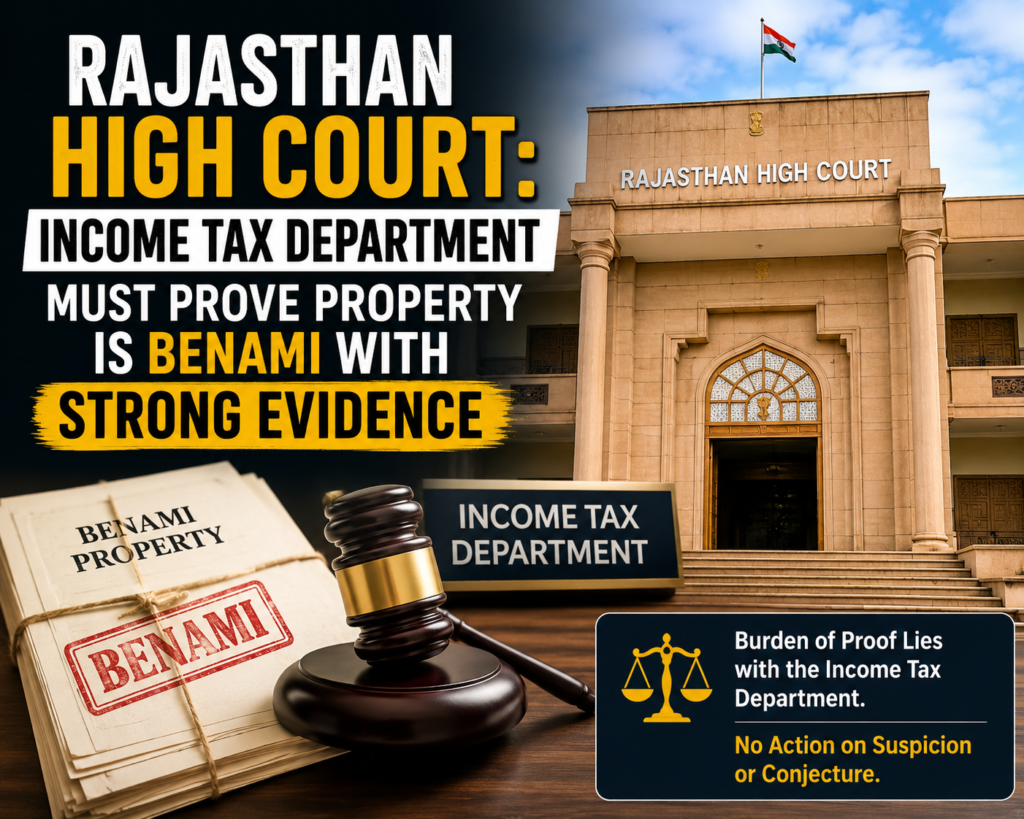
In a significant ruling on the Benami Property Act, the Rajasthan High Court has held that the burden of proving a property to be benami rests primarily on the Income Tax Department. The court emphasized that authorities must produce clear, credible, and convincing evidence before declaring any property benami, and that action cannot be based merely on suspicion, assumptions, or unverified statements.
The case concerned Jaipur-based M/s Alishan Complex Pvt. Ltd. In June 2022, the Income Tax Department provisionally attached 79 properties worth approximately ₹11.16 crore, alleging that they were benami assets. The department’s case was largely based on statements recorded during the investigation.
Benami law expert and High Court advocate Apoorva Jain Taran said the judgment sends a strong message that authorities must thoroughly verify documents, financial records, and supporting evidence before labeling any property as benami. A declaration based solely on statements, without proper verification, may not withstand judicial scrutiny.
Although the Benami Tribunal had upheld the department’s action on the ground that the actual benefit of the properties was allegedly accruing to another person, the company challenged the decision before the High Court.
A Division Bench comprising Justice Arun Monga and Justice Sandeep Shah observed that the principles of natural justice had not been fully followed during the proceedings. The court held that the company must be given a fair opportunity to present its case and directed that the matter be reconsidered through a fresh hearing.
The High Court further noted that proceedings under the Benami Transactions (Prohibition) Act and the Income Tax Act are distinct. However, when both proceedings arise from the same search operation and involve the same transactions, findings recorded under one law cannot be ignored without proper consideration under the other.
The court pointed out that, in this case, the Assessing Officer had already concluded that the company had purchased the properties through legitimate funds and banking channels, and that no additional tax liability arose from those transactions. These findings, the court observed, deserved due consideration in the benami proceedings.
The judgment is being viewed as an important clarification on the evidentiary standards required in benami property cases and reinforces the need for due process and fairness in such investigations.