A nine-judge Constitution Bench of the Supreme Court of India on Wednesday continued hearing petitions on alleged discrimination against women at religious places, including the Sabarimala Temple in Kerala. During the proceedings, the Court observed that it retains the authority to determine whether certain religious practices amount to superstition.
Representing the Centre, Solicitor General Tushar Mehta argued that a secular court should not decide such questions, as judges are experts in law, not religion. He submitted that it is the legislature’s role to enact laws, noting that statutes have already been framed to curb practices such as black magic.
Justice Joymalya Bagchi responded by asking whether a practice linked to witchcraft would qualify as superstition, and if so, whether the Court could intervene to maintain public order when the legislature remains silent. Mehta replied that judicial review can be exercised on grounds of health, morality, and public order — but not on the basis of superstition alone. The hearing will continue on Thursday.
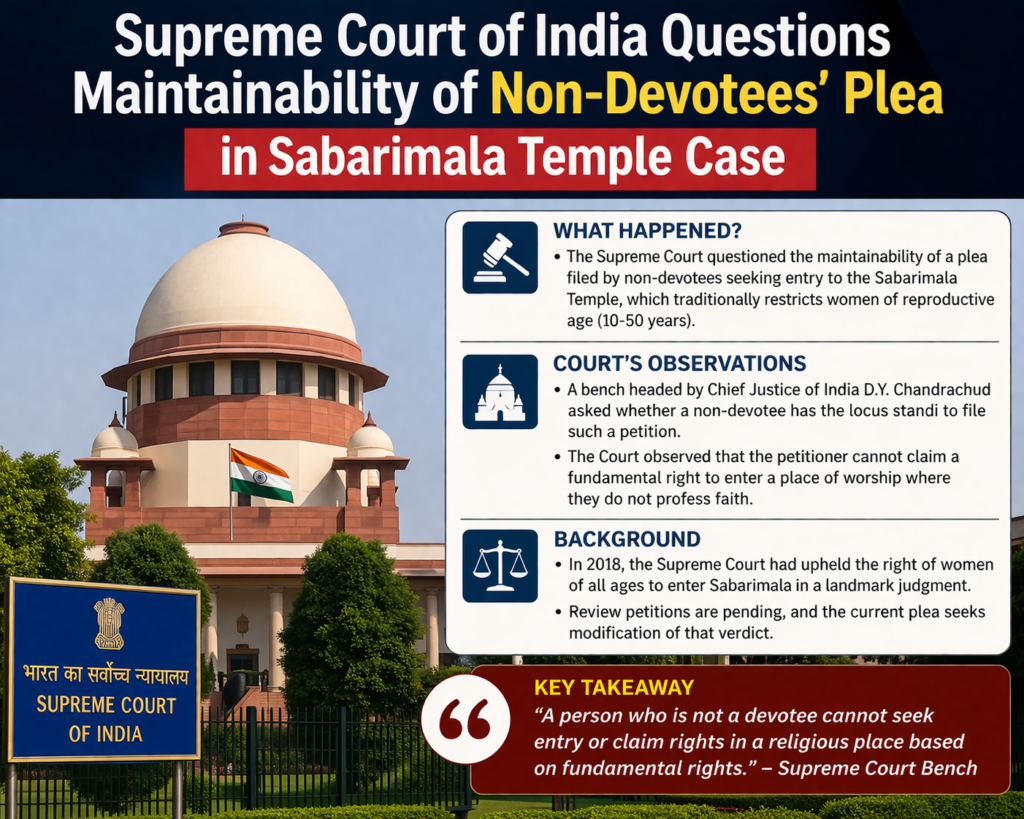
As the Bench was about to rise, Justice B. V. Nagaratna questioned Mehta about the identity of the petitioners in the Sabarimala matter, noting that the original petitioners did not appear to be devotees. Mehta clarified that the plea had been filed by the Indian Young Lawyers Association. Justice Nagaratna then remarked that since they were not devotees and had no direct connection with the temple, it raised the question whether such a writ petition should be entertained at all.
Posted inTOP STORIES