
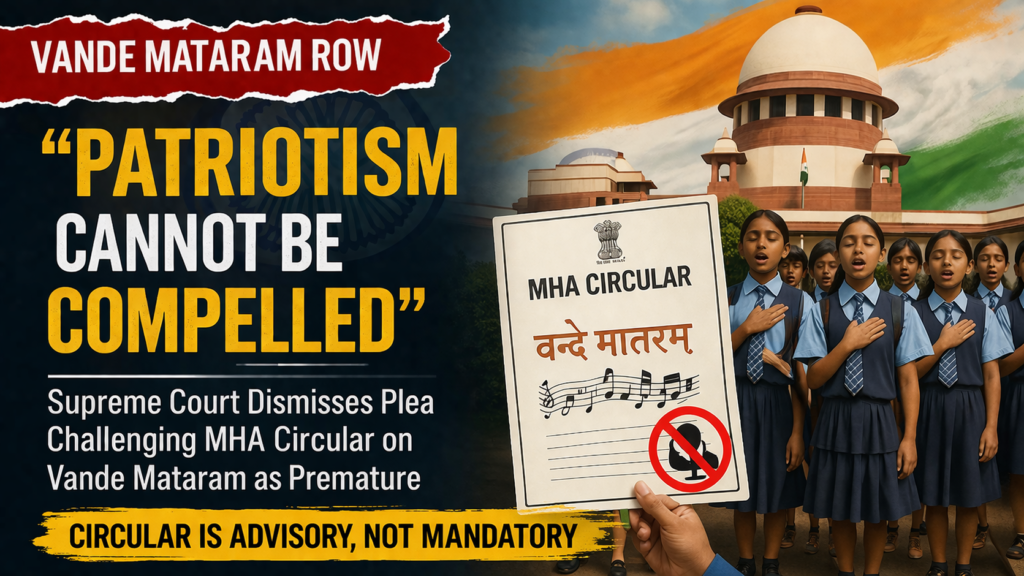
Senior Advocate Sanjay Hegde on Wednesday challenged a circular issued by the Ministry of Home Affairs (MHA) regarding the singing of Vande Mataram in schools, arguing before the Supreme Court that “patriotism cannot be compelled” and that the Constitution must protect individual conscience.
During the hearing, Chief Justice of India (CJI) Surya Kant questioned whether this argument would also apply to the National Anthem. In response, Hegde maintained that patriotism, by its very nature, cannot be enforced. He emphasized that constitutional values require safeguarding individual conscience and that India’s traditions are rooted in tolerance.
A bench comprising CJI Surya Kant, Justice Joymalya Bagchi, and Justice Vipul M. Pancholi was hearing a writ petition filed by Muhammed Sayeed Noori. The petition challenged the MHA circular dated January 28, which prescribed the singing of all stanzas of Vande Mataram and laid down protocols for its rendition in schools and offices.
After considering the submissions, the Court dismissed the petition as premature, noting that the circular was merely advisory in nature and did not mandate compulsory singing of the national song.
Hegde argued that even an advisory could create indirect pressure to conform. He pointed out that citizens, including atheists and individuals of different faiths, might feel compelled to participate in what he described as a “social demonstration of loyalty,” even if it conflicted with their beliefs.
Although Solicitor General Tushar Mehta was not formally appearing in the matter, he remarked that Article 51A of the Constitution imposes a duty to respect national symbols and questioned whether such respect required advisories. Hegde responded by distinguishing between the National Anthem and the National Song, noting that Article 51A specifically refers only to the former.
When the bench observed that there was no direct compulsion on the petitioner to sing the song, Hegde reiterated that the issue extended beyond the individual case, stressing again that patriotism cannot be forced.
The CJI noted that the argument regarding legal protection might have held more weight if there had been any element of compulsion in the circular. Hegde, however, highlighted that while the National Anthem is protected under the Prevention of Insults to National Honour Act, the National Song lacks a similar statutory framework.
Justice Bagchi also remarked that the petitioner’s concerns about potential discrimination were vague. Ultimately, the Court dismissed the plea as premature.
The petitioner had argued that the circular effectively integrated participation in the singing of Vande Mataram into school activities, creating a risk of social pressure, disciplinary action, or stigma for those who chose not to participate.
The plea further contended that this placed individuals—particularly from minority or monotheistic faiths—in a difficult position of either acting against their conscience or being perceived as disrespecting a national symbol.
It was also pointed out that Article 51A(a) mentions respect for the Constitution, National Flag, and National Anthem, but makes no reference to the National Song.
Relying on the Supreme Court’s judgment in Bijoe Emmanuel v. State of Kerala, the petitioner argued that if students cannot be compelled to sing the National Anthem on grounds of conscience, they should similarly not be forced to participate in singing the National Song.
The petition raised several key grounds:
- The circular violated the right to freedom of conscience and religion under Article 25, as the song contains devotional elements that may conflict with certain beliefs.
- It amounted to compelled expression, infringing Article 19(1)(a), by encouraging organized, institutional recitation.
- It contradicted the Bijoe Emmanuel ruling, which protects the right not to sing.
- It undermined secularism and failed to account for the need to protect freedom of thought and belief within educational institutions.
Case Details: MUHAMMED SAYEED NOORI Versus UNION OF INDIA AND ORS., W.P.(C) No. 341/2026
Heated Clash: Supreme Court Grapples with Manipur Violence Burial Dispute