
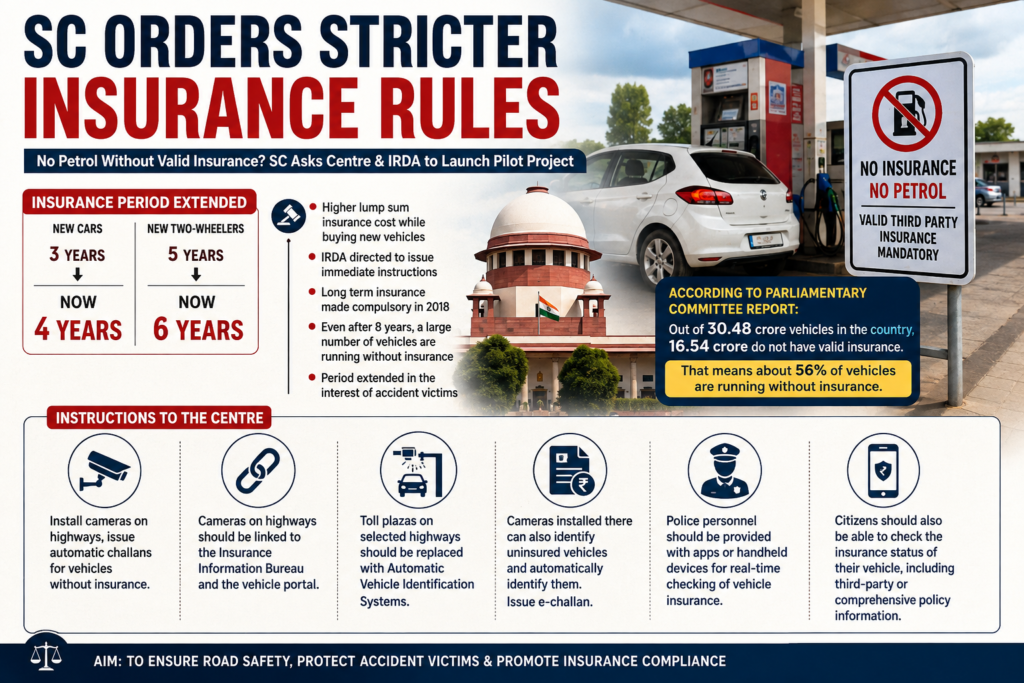
The Supreme Court has directed the Central Government and the Insurance Regulatory and Development Authority of India (IRDAI) to prepare a pilot project under which fuel may not be supplied to vehicles that do not have valid third-party insurance. The direction was issued by a bench comprising Justice Sanjay Karol and Justice Prashant Kumar Mishra.
The Court has also increased the mandatory long-term insurance period for new vehicles. For new cars, the compulsory insurance period has been extended from three years to four years, while for new two-wheelers it has been increased from five years to six years. As a result, buyers will have to pay a higher one-time insurance premium at the time of purchase. IRDAI has been asked to issue immediate instructions in this regard.
The bench noted that long-term insurance was made mandatory in 2018, but despite eight years having passed, a significant number of vehicles continue to operate without valid insurance. Considering the interests of road accident victims, the Court found it necessary to extend the insurance period by an additional year.
Key Directions to the Centre
Install cameras on highways to detect uninsured vehicles.
Link highway cameras with the Insurance Information Bureau and the VAHAN vehicle database.
Introduce automatic e-challans for vehicles found without valid insurance.
Replace toll plazas on selected highways with Automatic Vehicle Identification Systems capable of identifying uninsured vehicles.
Equip police personnel with mobile applications or handheld devices for real-time verification of vehicle insurance.
Enable citizens to check the insurance status of their vehicles, including details of third-party and comprehensive insurance policies.
According to a Parliamentary Committee report, out of 30.48 crore registered vehicles in India, 16.54 crore do not have valid insurance coverage. This means nearly 56% of vehicles on Indian roads are operating without insurance.
Posted inTOP STORIES