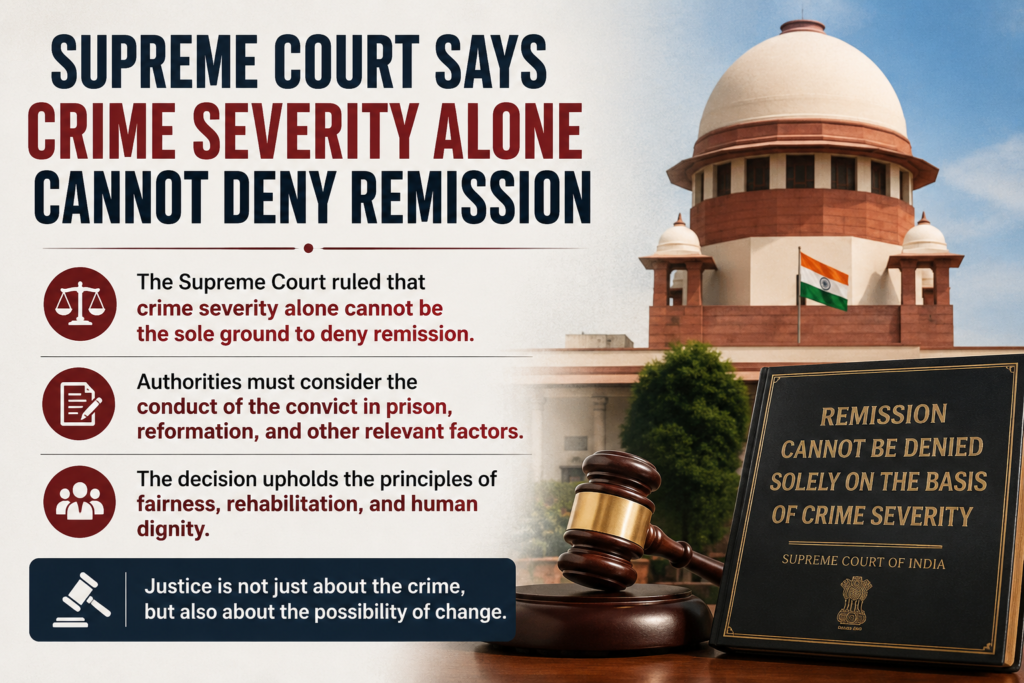
The Supreme Court has granted the plea for premature release filed by Rohit Chaturvedi, who was convicted in the 2003 murder case of poet Madhumita Shukla. The court observed that the nature or gravity of a crime alone cannot be used as the sole ground to deny remission.
A bench comprising Justice B V Nagarathna and Justice Ujjal Bhuyan set aside the Union Home Ministry’s July 9, 2025 order rejecting Chaturvedi’s premature release, despite a recommendation in his favour by the Uttarakhand government.
The bench stressed that the purpose of remission is centered on a prisoner’s reform and reintegration into society, not on extending punishment indefinitely. The court said remission must be assessed on the basis of present conduct, evidence of improvement, and the possibility of rehabilitation. It added that denying remission solely because of the seriousness of the offence defeats the very purpose of the policy.
The Supreme Court further remarked that justice does not allow a person to remain imprisoned forever under the shadow of their worst act. Since Rohit Chaturvedi is already out on bail, the court clarified that he would not be required to surrender.
Unnao Rape Case
In another matter, the Supreme Court set aside the Delhi High Court’s order suspending the life sentence of former BJP MLA Kuldeep Singh Sengar in the 2017 Unnao rape case.
The bench, headed by the Chief Justice of India along with Justice Joymalya Bagchi, directed the High Court to reconsider Sengar’s plea afresh. The court also instructed the High Court to decide Sengar’s main appeal challenging his conviction and life sentence within two months.
Shiv Sena Election Symbol Dispute
The Supreme Court also expressed displeasure over statements made by certain political leaders regarding the Shiv Sena election symbol dispute. The bench cautioned against making irresponsible public comments suggesting that the court was delaying the hearing or decision in the matter.
The court observed that such remarks are unacceptable, especially when parties themselves seek adjournments and later claim publicly that the case is not being decided. The bench, comprising the Chief Justice of India and Justice Joymalya Bagchi, advised political leaders to exercise restraint and responsibility in their public statements.