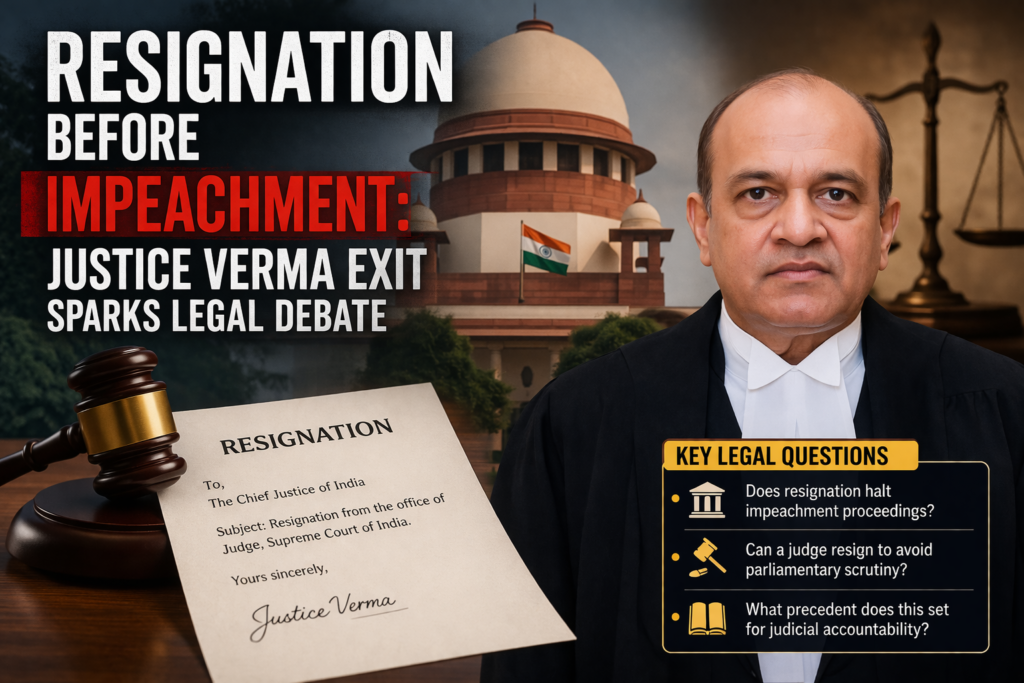
Justice Yashwant Verma of the Allahabad High Court has resigned from his post, nearly a year after burnt cash was allegedly discovered at his Delhi residence. His resignation was sent to Droupadi Murmu on April 9, amid intensifying impeachment proceedings. More than 140 members of the Lok Sabha had supported a motion seeking his removal.
In his letter, the 57-year-old judge said he was stepping down with “deep pain,” adding that it had been an honour to serve. Earlier, Justice Verma had declined advice from then Chief Justice Sanjiv Khanna to resign. On January 16, the Supreme Court of India dismissed his petition challenging the Lok Sabha Speaker’s acceptance of the impeachment motion and the validity of the inquiry panel.
The controversy began on March 14 last year when a fire broke out at Justice Verma’s official residence in Delhi. While dousing the flames, authorities reportedly found piles of cash nearly 1.5 feet high. Justice Verma denied any connection, stating neither he nor his family had stored money in the room.
What happens to impeachment now?
If the President accepts his resignation, the impeachment proceedings may become infructuous and automatically lapse. Previously, judges like Soumitra Sen and P. D. Dinakaran avoided removal after resigning. In fact, no judge has been removed through impeachment in the 75 years since the Constitution came into force.
However, questions remain over whether the resignation will be accepted. Under newer service norms, voluntary retirement or resignation of officials facing investigation is not readily approved. This raises the possibility that Justice Verma could still face impeachment rather than exit through resignation.
Possible criminal probe
Even if the resignation is accepted, he could face criminal investigation. Police, the CBI, and possibly the ED may examine the matter under the Prevention of Corruption Act, including a potential hawala angle. His government pension, post-retirement benefits, and future legal practice — including eligibility for senior advocate status — may also come under scrutiny.
The controversy has also renewed demands for stricter accountability mechanisms, including mandatory public disclosure of judges’ assets. Judges had earlier voluntarily agreed to declare assets in 1997 and again in October 2009.
Justice Verma’s defence
Justice Verma has written 13 letters to the inquiry committee denying all allegations. He called the process “one-sided, unfair, and biased.” He said he was out of town when the fire broke out on March 14, 2025, and that domestic staff and maintenance personnel had access to the storeroom. He also claimed the committee ignored the fire report, examined witnesses in his absence, and effectively reversed the burden of proof.
Citing public humiliation, he said he was being forced to prove his innocence without credible evidence and has refused to participate further in the inquiry.