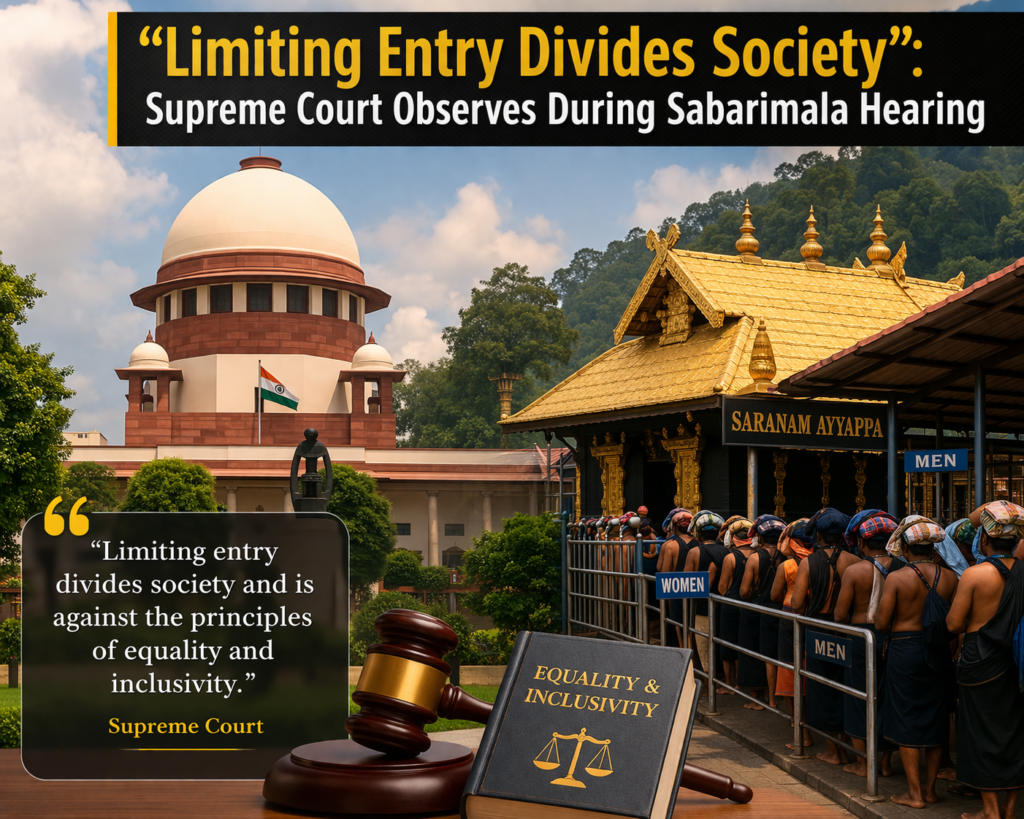
The Supreme Court on Thursday observed that everyone should have the right to enter temples and monasteries, stating that excluding any particular community could harm Hinduism and create divisions in society. A nine-judge Constitution Bench made the remarks on the third day of hearings related to the Sabarimala issue and alleged discrimination against women at religious places.
Senior advocate C.S. Vaidyanathan, appearing for the Nair Service Society and others, argued that temples belonging to specific communities should be allowed to restrict worship to their own followers. Responding to this, Justice B.V. Nagarathna remarked that limiting entry rights would negatively impact Hinduism. Justice Aravind Kumar agreed, adding that such exclusion would divide society.
During the hearing, Solicitor General Tushar Mehta submitted that there are also temples dedicated to Goddess Bhagwati where men are not allowed entry. He noted that in some temples male priests wash the feet of female devotees, married men are barred from entering the Brahma Temple in Pushkar, and in a temple in Kerala men must wear feminine attire to enter. He argued that the issue is not about male-centric or female-centric beliefs, but about diverse religious practices.
Additional Solicitor General K.M. Nataraj said that religious rights are protected and regulated under Articles 25 and 26 of the Constitution. He explained that Article 25(1) guarantees freedom of faith, practice, and propagation of religion, while Article 25(2) allows the State to introduce reforms and remove social evils. He added that a religious sect is built on shared collective beliefs.
Justice Ahsanuddin Amanullah questioned whether the outward expression of inner religious beliefs should also be protected, asking how such protection could be justified if it affects the rights of others.
Responding, Nataraj argued that while interpreting the Constitution, reliance should be placed on India’s own constitutional practice and understanding, rather than on constitutions of countries like Ireland or Poland, emphasizing interpretation within the Indian constitutional framework.
Posted inTOP STORIES