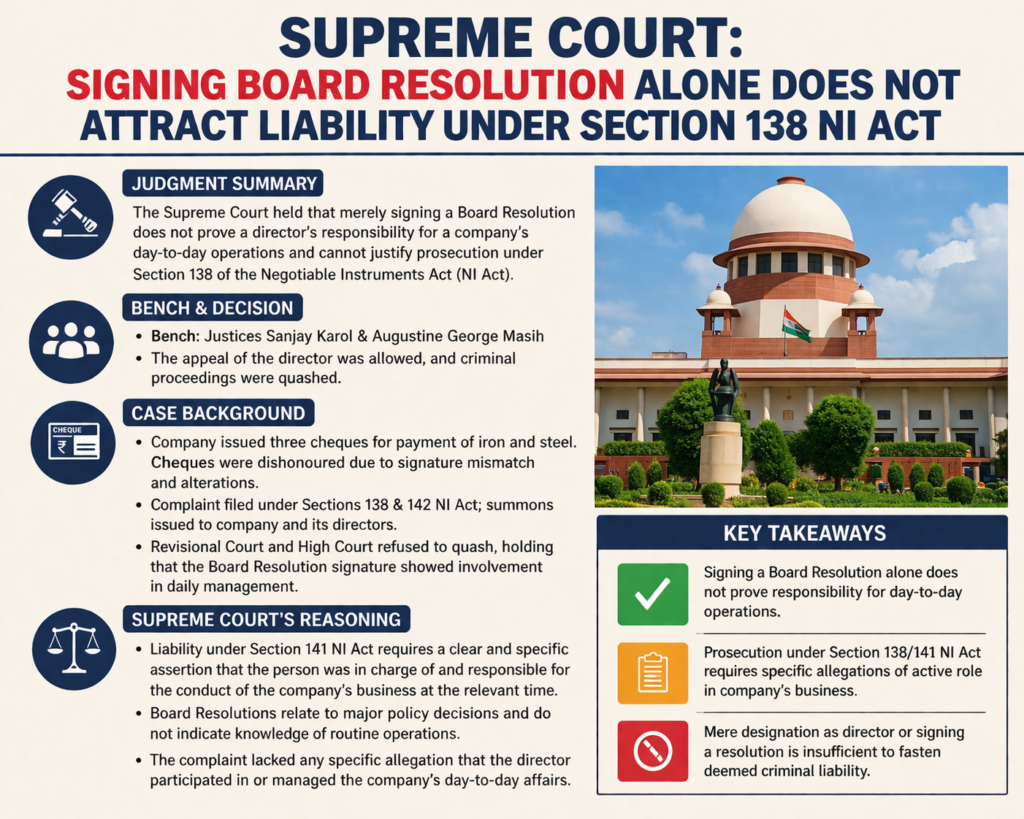
The Supreme Court ruled that simply signing a Board Resolution does not prove that a company director was responsible for the company’s day-to-day operations. Therefore, such a fact alone cannot justify prosecuting a director under Section 138 of the Negotiable Instruments Act for cheque dishonour.
A bench of Justices Sanjay Karol and Augustine George Masih allowed the appeal of a director and quashed the criminal proceedings against her. The Court noted that the complaint contained no specific allegations showing that she actively participated in the company’s business or handled its daily affairs.
The matter arose after three cheques issued by a company for payment of iron and steel were dishonoured due to signature mismatch and alterations. Following this, a complaint was filed under Sections 138 and 142 of the Negotiable Instruments Act, and summons were issued to the company and its directors. The appellant director challenged the summoning order, but both the revisional court and the High Court refused to quash the proceedings, holding that her signature on a Board Resolution indicated involvement in daily management.
Setting aside this reasoning, the Supreme Court emphasized that liability of directors under Section 141 of the Act requires a clear and specific assertion that the person was in charge of and responsible for the conduct of the company’s business at the relevant time. The Court explained that Board Resolutions are typically signed for major policy decisions and do not necessarily show knowledge of routine operational transactions.
Since the complaint lacked any direct allegation about the director’s role in the company’s day-to-day functioning, the Court held that the prosecution could not continue. It also clarified that merely holding the position of director or signing a resolution is insufficient to impose deemed liability without specific factual claims.
Posted inTOP STORIES